NASA and NSF Laud New NRC Decadal Survey on Solar and Space Physics
Just over a week away from the launch of NASA’s next heliophysics mission, the Radiation Belt Storm Probes (RBSP), the National Research Council (NRC) today released its second Decadal Survey for that field of space science. So far, reaction from the study’s sponsors is very positive.
NRC Decadal Surveys lay out the top science questions in various scientific disciplines, and missions NASA or other agencies should conduct to answer them, over the next 10 years. The NRC studies are conducted about every 10 years, a decade, hence the term “decadal.”
This is the second report for the discipline that studies the sun and its influence on the Earth and the rest of the solar system. NASA currently refers to this field of science as heliophysics, though it has been called solar and space physics or solar-terrestrial physics in the past. Each formulation has nuanced differences. The NRC calls it solar and space physics. The first solar and space physics Decadal Survey was issued in 2003.
This new report, Solar and Space Physics: A Science for a Technological Society, was requested by NASA and the National Science Foundation (NSF). Barbara Giles, director of NASA’s Heliophysics Division, and Richard Behnke, her counterpart at NSF, both praised the report’s recommendations at an NRC press event today.
The report emphasizes the research needed to better understand the sun’s activity, especially in terms of its societal impact when solar storms disrupt communications networks, the electric grid, and GPS navigation satellites, for example.
Daniel Baker, Director of the Laboratory for Atmospheric and Space Physics at the University of Colorado and chair of the study, said the committee was “highly cognizant” of the current budget constrained environment when recommending missions to achieve the four key goals identified in the report:
- establish the origin of the sun’s activity and predict variations in the space environment;
- determine the dynamics and coupling of Earth’s magnetosphere, ionosphere, and atmosphere and their response to solar and terrestrial inputs;
- understand the interaction of the sun with the solar system and the interstellar medium; and
- discover and characterize fundamental processes that occur both within the heliosphere and throughout the universe.
The study offered five top priorities for research and two for applications.
In terms of research, completing the current program, which includes RBSP, is the first priority, according to Baker and study vice chair Thomas Zurbuchen of the University of Michigan. The other four are:
- implement what the report calls the “DRIVE” initiative;
- accelerate and expand the Heliophysics Explorer program;
- restructure the solar-terrestrial probes (STP) program as a moderate-scale Principal Investigator (PI)-led effort; and
- implement a large Living with a Star (LWS) mission such as a Geospace Dynamics Constellation (GDC).
DRIVE stands for Diversify, Realize, Integrate, Venture, Educate. Baker and Zurbuchen described it as an effort to unify the solar and space physics community so it can take advantage of opportunities later in the decade. “We can only make progress if all the agencies are moving forward effectively together,” Baker stressed. Zurbuchen called it “investing in the community.”
Baker said the study committee is convinced that these priorities can be executed within the expected budget. The report includes the following chart to show how the recommendations match with budget expectations, which include what it calls “modest” increases after FY2017.
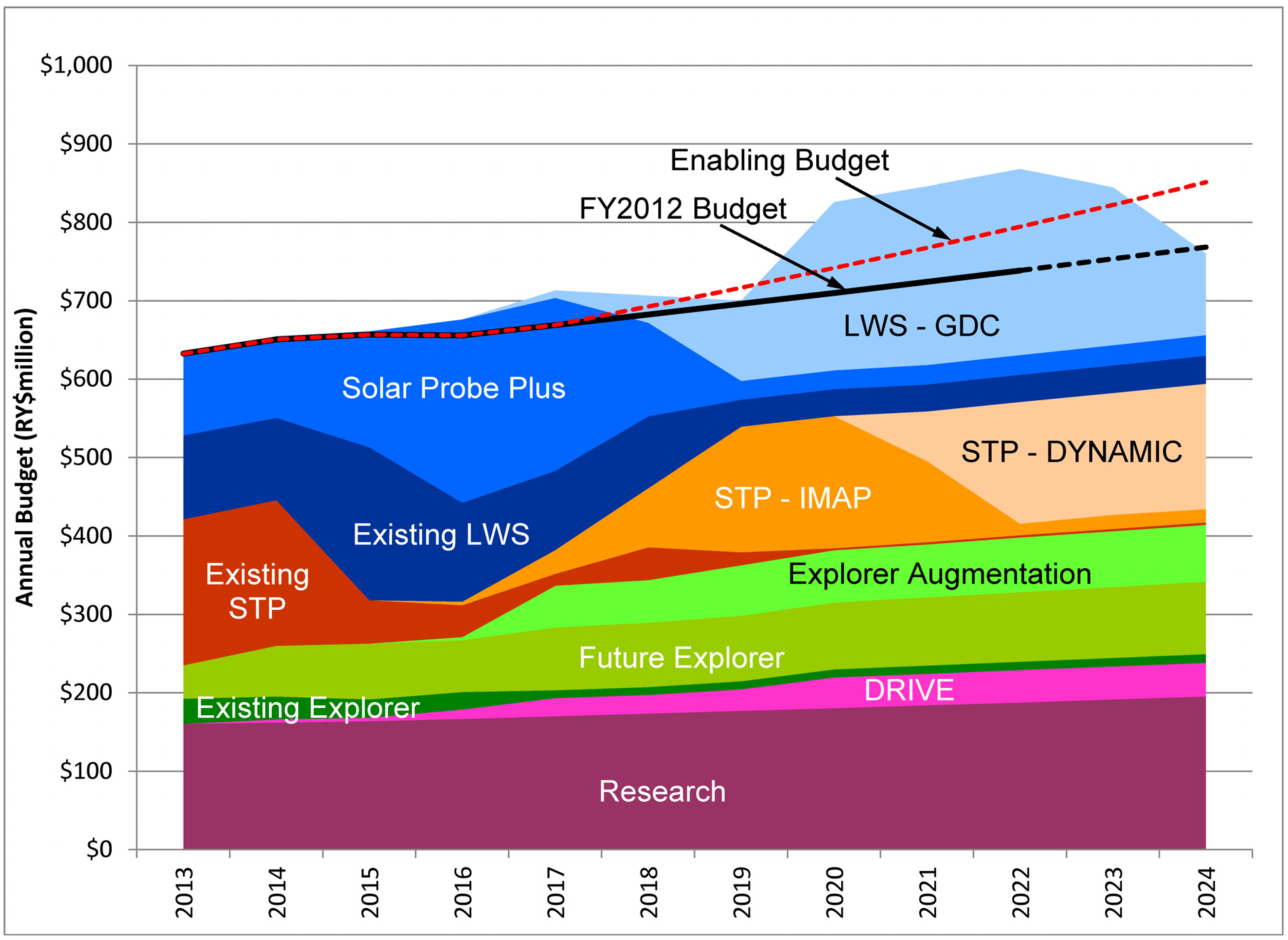 FIGURE S.1 Heliophysics budget and program plan by year and category from 2013 to 2024. The solid black line indicates the funding level from 2013 to 2022 provided to the committee by NASA as the baseline for budget planning, and the dashed black line extrapolates the budget forward to 2024. After 2017 the amount increases with a nominal 2 percent inflationary factor. Through 2016 the program content is tightly constrained by budgetary limits and fully committed for executing existing program elements. The red dashed “Enabling Budget” line includes a modest increase from the baseline budget starting in 2017, allowing implementation of the survey-recommended program at a more efficient cadence that better meets scientific and societal needs and improves optimization of the mix of small and large missions. From 2017 to 2024 the Enabling Budget grows at 1.5 percent above inflation. (Note that the 2024 Enabling Budget is equivalent to growth at a rate just 0.50 percent above inflation from 2009.) GDC, the next large mission of the LWS program after SPP, rises above the baseline curve in order to achieve a more efficient spending profile, as well as to achieve deployment in time for the next solar maximum in 2024. NOTE: LWS refers to missions in the Living With a Star line and STP refers to missions in the Solar-Terrestrial Probes line.
Source: National Research Council. Solar and Space Physics: A Science for a Technological Society. National Academies Press, Washington, DC, 2012, p. S-10.
Just in case budgets are less (or more) than that, this Decadal Survey, like the planetary science Decadal Survey issued last year, offers “decision rules” on how to cope.
For applications, the study identifies two priorities:
- Recharter the National Space Weather Program, and
- Work in a multi-agency NASA-NSF-DOD partnership for solar and solar wind observations, and the National Oceanic and Atmospheric Administration (NOAA, part of the Department of Commerce) should establish a space weather research program to effectively transition research to operations.
The study committee wants the National Space Weather Program (NSWP) to be chartered under the White House National Science and Technology Council (NSTC) and include the active participation of the White House’s Office of Science and Technology Policy (which administers the NSTC) and Office of Management and Budget (OMB). The NSWP is currently administered by NOAA’s Office of the Federal Coordinator for Meteorological Services and Supporting Research.
NASA’s Giles said NASA was “very pleased to receive the report” and she especially appreciates its “definition of new ways of working between the agencies and with international partners.” NSF’s Behnke was even more enthusiastic, calling it “a remarkable set of recommendations.” Saying that he likes and wants to do all of them, he added: “Now it is our turn. You’ve passed the baton on to us. … This will be a decade of working together with agency partners more than ever.”
Although NOAA and DOD were not sponsors of this study, the report recommends that all four agencies work together.
User Comments
SpacePolicyOnline.com has the right (but not the obligation) to monitor the comments and to remove any materials it deems inappropriate. We do not post comments that include links to other websites since we have no control over that content nor can we verify the security of such links.