Subscribe to Email Updates: |
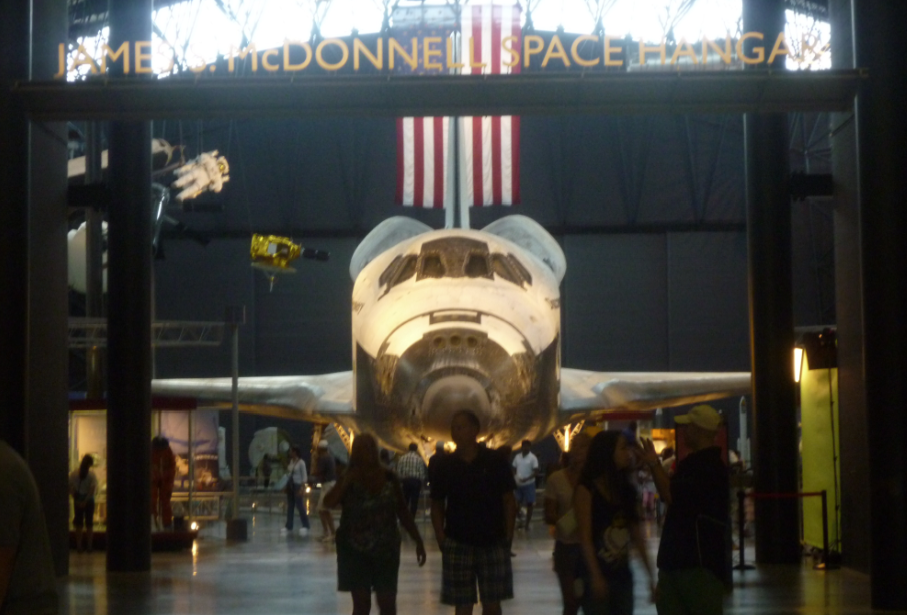
Commentary and Book ReviewsRediscovering Discovery: A SpacePolicyOnline.com Commentary--Photos AddedEditorial Commentary by Laura M. Delgado after visiting the Discovery space shuttle orbiter at the Smithsonian's Udvar-Hazy Center. This story has been updated adding photos of the visit. Having never visited the National Air & Space Museum (NASM) Steven F. Udvar-Hazy Center in the few years I have been living in DC is akin to going only sporadically to the beach when I was growing up in Puerto Rico. Embarrassing, yes, but so easy to do. That’s why this past Saturday when a friend (with a car) suggested venturing out to Chantilly, VA, I simply could not refuse. We did not get to see Space Shuttle Discovery right away. After a persistent rain had cleared away, we took the opportunity to go up to the observation tower and see planes coming in and out of Dulles International Airport just a few miles away. As we picked up new facts about flying, we heard the real-time talk of flight controllers and saw blips of planes in the vicinity of the Newark airport in New Jersey on a radar screen. Back in the main building, we went to the Boeing Aviation Hangar first and were just awestruck at the many kinds of engines, models and planes that are packed up in that one space. We picked our favorites (based on color, symbols on the wings, size or shape) and got up for a closer look: a World War II German plane, the French Concord, and a couple of colorful aerobatic aircraft made the cut. The sampling was enough for us to comment often on the bravado of those who had braved the skies for the first time in such fantastic-looking vehicles. Eventually, of course, the pull of the Space Shuttle, sitting silently in the middle of the James S. McDonnell Space Hangar, was just too strong. I had seen Discovery once before. Back in April, before it moved into its new location, it sat on top of what seemed a gigantic plane that flew over the city, drawing the gaze of thousands. I was one of so many who clambered up to the rooftop of their buildings, hoping to catch a glimpse of it. And we did -- on its way from Dulles and into the city, Discovery flew over us in Arlington, Va., not once but three times, giving us different perspectives and making us clap and scream with inexplicable joy. At the museum, of course, the experience was quieter. I gazed at the vehicle with an interesting mixture of disbelief – at both how small and how big it looked, at how seemingly fragile – and of certainty, as I recalled what several years of being in the space policy field have taught me about the program. The many successes, the failures, and the history of its conception and its closure, were all remembered in that one moment as I tried to angle my camera just right to capture it in its entirety. The scuff marks, the dust and grit, the instructions to astronauts written in bold letters, the thermal tiles – those tiles, that featured so prominently for the Nation in 2003 – all of this caught my attention as I circled Discovery.
Space Shuttle Orbiter Discovery at the James S. McDonnell Space Hangar of the Smithsonian Institution's National Air and Space Museum's Udvar-Hazy Center, August 2012. Photo Credit: Laura M. Delgado
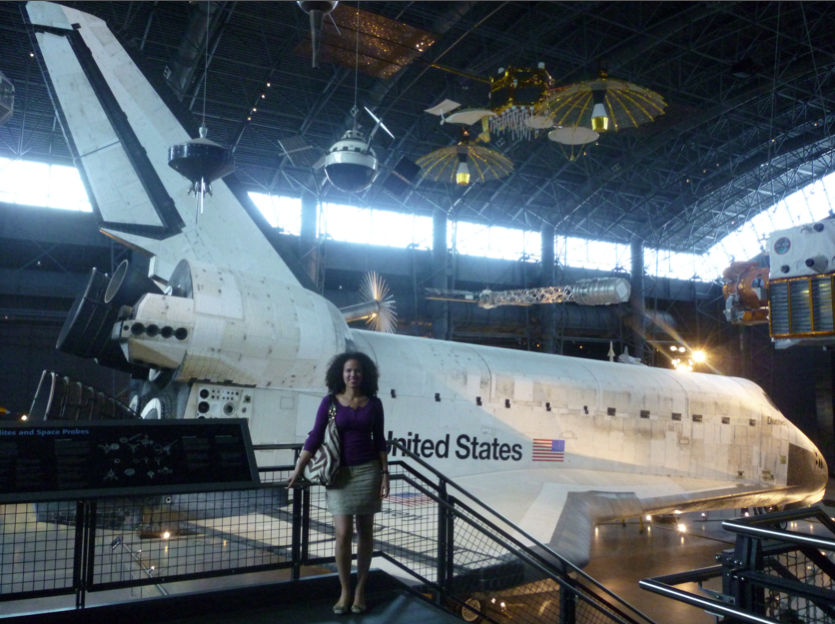
SpacePolicyOnline.com correspondent Laura M. Delgado poses next to the space shuttle Discovery orbiter at the James S. McDonnell Space Hangar of the Smithsonian Institution's National Air and Space Museum's Udvar-Hazy Center, August 2012. Photo Credit: Laura M. Delgado While my connection to space is policy not technical, I have to admit that in this one moment, I felt the shuttle to be quite real. Everything about it, what I know, what I will keep learning and what I don’t yet understand, was evidence to me that I was looking not at a symbol but a real component of the space program. I saw many things on Saturday that surprised me, made me wonder, but the privilege of seeing Discovery up close for the first time definitely stayed with me. Yes, Discovery, like the other shuttles, is not flying any more. But for those of us who venture out to see them, it’s like getting a flavor of space and our history in it in a very personal way while inviting an opportunity to ponder over and hope for what comes next. Space Junk 3D: A Space PolicyOnline.com Movie ReviewWhirling space trash and panoramic views of Arizona's Meteor Crater are only two of the reasons to see a new 3D movie -- Space Junk 3D. Shown last night at the Smithsonian Museum of Natural History's IMAX theater as part of the Environmental Film Festival, the Melrae Pictures film tells the story of Don Kessler, the "father of space junk," and raises public awareness about the issue that has defined his career. Using the natural collisions of the universe as an analogy, the film has great computer-generated 3D imagery of asteroids colliding with each other and breaking into pieces that impact the Earth -- hence the inclusion of Meteor Crater -- and galaxies crashing into each other to form new galaxies. It is a useful technique to then explain the thousands of objects in Earth orbit that may collide with each other and form yet more debris that imperils operating spacecraft. An arcane and complicated subject-- how many people even know the difference between LEO and MEO or MEO and GEO -- the film uses storytelling to capture the public's interest and 3D animation to provide a visual reference. Lively questions from the audience of perhaps 150 people after the film was over suggested that they got the point that there's a problem even if the details and solutions were not apparent. Experts may quibble with a few of the facts (weather satellites are not in MEO), the sequencing is odd in places (one moment talking about GEO, the next about the Chinese ASAT test in 2007), the ending verges on silliness (depicting a giant orbiting recycling station that would dwarf ISS), and it does have a Carl Sagan-ish quality in almost gloryifying Kessler, but overall it is a useful and fun method to raise public awareness about the need for space sustainability. Kudos to Melissa Butts and Kimberly Rowe who produced and directed the film. Visit the Melrae Pictures website for information on where to see it. New York Times Calls $2.5 Billion Mars Curiosity Rover a "Tidbit"SpacePolicyOnline.com Editorial Commentary In a news story today, the New York Times bemoans the cut to robotic Mars exploration plans, adding that "There are still a few tidbits left." It identifies the "tidbits" as the Mars Curiosity rover currently enroute to Mars and the MAVEN mission scheduled for launch next year. Curiosity hopefully will make a successful landing on Mars in August, though the novel "sky crane" landing system will have everyone biting their nails during descent. Twice as long and five times as heavy as the Spirit and Opportunity rovers already on Mars, Curiosity is the size of a mini Cooper and designed to roll over obstacles up to two feet high. Its scientific equipment is 10 times more massive than the earlier rovers. Not to mention -- and the New York Times does not -- that its life cycle cost is $2.5 billion, a 56 percent overrun according to NASA's Inspector General. That's quite a tidbit. The Mars Atmosphere and Volatile EvolutioN (MAVEN) mission is indeed a less ambitious mission. An orbiter rather than a lander, it will try to determine what caused "the Martian atmosphere -- and water -- to be lost to space." GAO reports that MAVEN will cost $671 million. That may be a tidbit in comparison to Curiosity, but certainly not to the average American taxpayer. Across the land, everyone wants to cut the deficit -- as long as it's not THEIR program that suffers as a result. It is certainly fair for the Mars community to fight for their program; that's how the game is played. One would hope, however, that the news media would refrain from picking favorites except on their editorial pages. For that matter, what program(s) would the New York Times prefer to have cut instead, or does it believe that NASA should be exempt from cuts? That is a weighty question on which the esteemed newspaper probably should comment. In the meantime, with all due respect, calling a $2.5 billion Mars rover a "tidbit" is laughable. Falling Back to Earth: Mark Albrecht's Memoir of the National Space Council 1989-1992--A SpacePolicyOnline.com Book ReviewMany human spaceflight advocates consider the imminent termination of the space shuttle and the lack of commitment to a future human space exploration program as U.S. abdication of its leadership in space. Mark Albrecht, former Executive Director of the White House's National Space Council under President George H. W. Bush, is one of them. In his new book, Falling Back to Earth: A First Hand Account of the Great Space Race and the End of the Cold War, Albrecht provides a very personal account of his years in the Bush Administration - that's the first Bush Administration, not the more recent George W. Bush presidency - working with Vice President Dan Quayle as they tried their hand at getting American astronauts out of Earth orbit. Breathing New Life into the Debate Over Human SpaceflightSpacePolicyOnline.com's correspondent Laura Delgado comments on the need to reconsider the paradigms that have shaped the U.S. human spaceflight program over the past 50 years in this commentary, dated May 4, 2011. Eight Years After Columbia, Nation Still Lacks Consensus on Vision for Future Human SpaceflightEight years after the space shuttle Columbia tragedy, the nation seems as uncertain about the future of the human spaceflight program as it did then. Read our commentary on the eighth anniversary of the Columbia accident. The Policy Side of Things: A Student's View of AIAA's Space 2010 ConferenceSpacePolicyOnline.com correspondent Laura M. Delgado, a graduate student at GWU's Space Policy Institute, attended her first AIAA conference last week -- Space2010 -- and presented her first conference paper. Read about her impressions of the conference, highlights of the sessions she attended, and a synopsis of her paper. Witnessing the STS-130 Launch and the Ending of an EraSpacePolicyOnline.com correspondent Laura M. Delgado was in Florida to watch the STS-130 launch -- her first. Read her commentary on her impressions of the launch and of the end of the space shuttle era. It's More than a 90-Day Job: A SpacePolicyOnline.com EditorialRead It's More Than a 90-Day Job, a SpacePolicyOnline.com editorial about the need to give the Augustine panel the time it needs to formulate a solid foundation for choices about the future of the human space flight program.
Missing the Mark: A SpacePolicyOnline.com EditorialRead "Missing the Mark," a July 23, 2009 SpacePolicyOnline.com editorial about the need for President Obama to take command of NASA's future.
|